
Why the plan to live near your friends dies in the group chat — and how to keep it alive
Here's a story we watch play out over and over at Live Near Friends.
Three couples decide they want to live near each other. The goal is three private homes next door to each other.
It's a beautiful idea. Everyone's excited. The group chat is on fire.
And then, most of the time, nothing happens. The dream quietly dies somewhere between "we should totally do this" and "okay but which property."
Why?
After helping a lot of these groups, we've found the difference between the ones that happen and the ones that don't comes down to one thing: the plans that succeed have one or two households willing to take the leap. The plans that fail have three or more households waiting to come to consensus.
Where it dies
The death scene almost always looks the same. It happens in the group chat, and it goes like this:
Couple A: Let's do it
Couple B: Let's do it
Couple C: Eh, I don't like the kitchen layout
And that's it. The thread goes quiet.
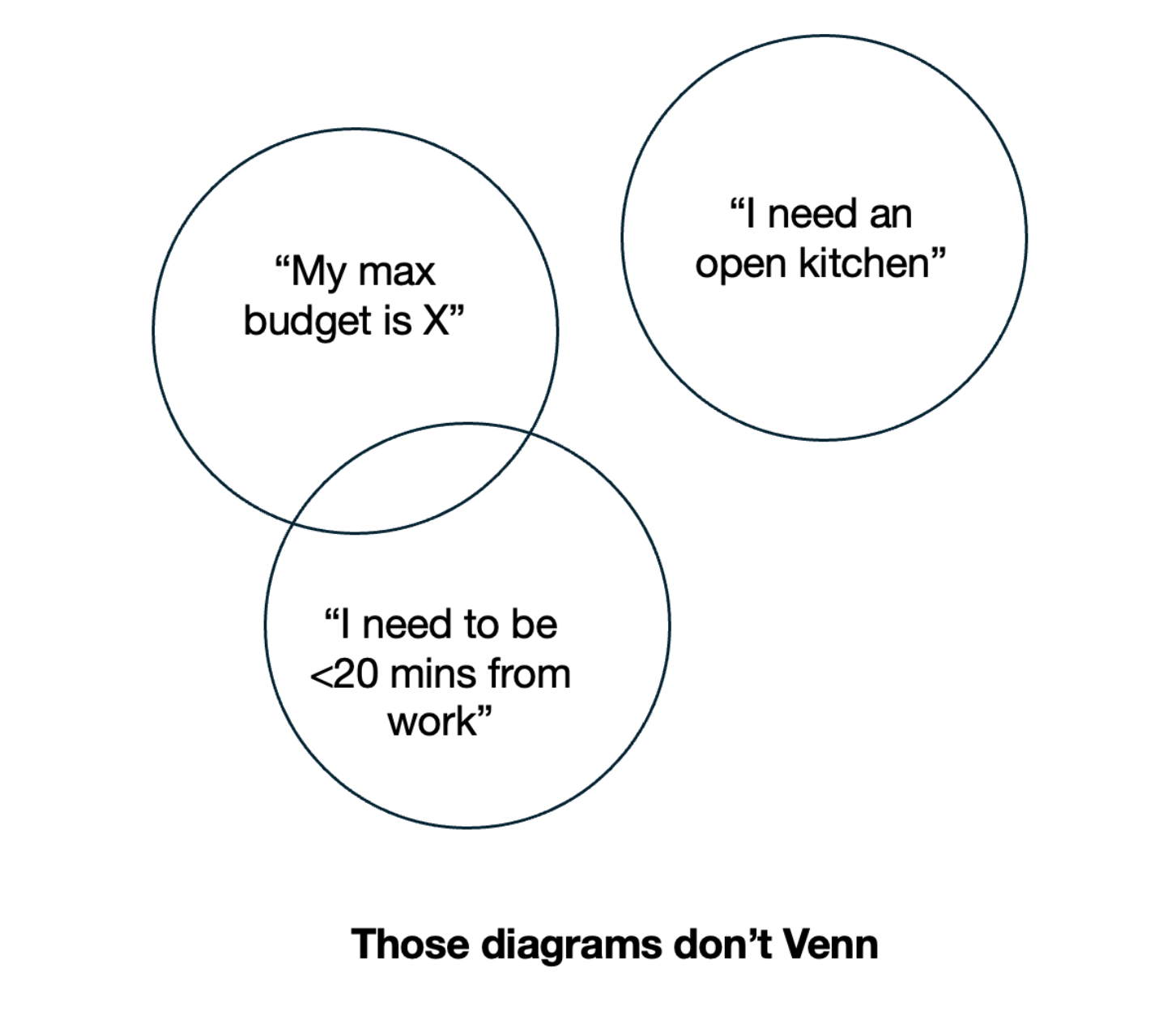
Here's the thing: Couple C's objection isn't crazy. A bad kitchen layout is a real annoyance. But buried inside it is an assumption that almost never holds up — that somewhere out there sits another identical setup, three similar houses on one lot, except with an open-plan kitchen in Couple C's.
I'm sorry. There almost certainly isn't.
So in trying to protect themselves from a closed-off kitchen, Couple C just traded away the entire thing. The decision wasn't actually "this house vs. a slightly better house." They traded "living next door to people we love" for "living alone, with my ideal kitchen." The kitchen layout was a rounding error on the benefits of the lifestyle. They just couldn't see it in the moment.
There is no compound that's perfect for everyone
This is the idea I most want you to take away: There is no single property that perfectly fits three households' wish lists at once. That magic place that nails everyone's budget, school district, square footage, and taste in kitchens? It doesn't exist.
Which means somebody, on some dimension, is not going to get their first choice. That's not a sign your group is doomed. It's just math. So there are really only two outcomes: people get on board despite a preference or two, or the plan falls apart. There's no secret third option where everyone's checklist gets fully satisfied.
Let's actually do the math
Say that, for any one household, about one in five homes on the market is a genuine fit. (Generous, honestly.)
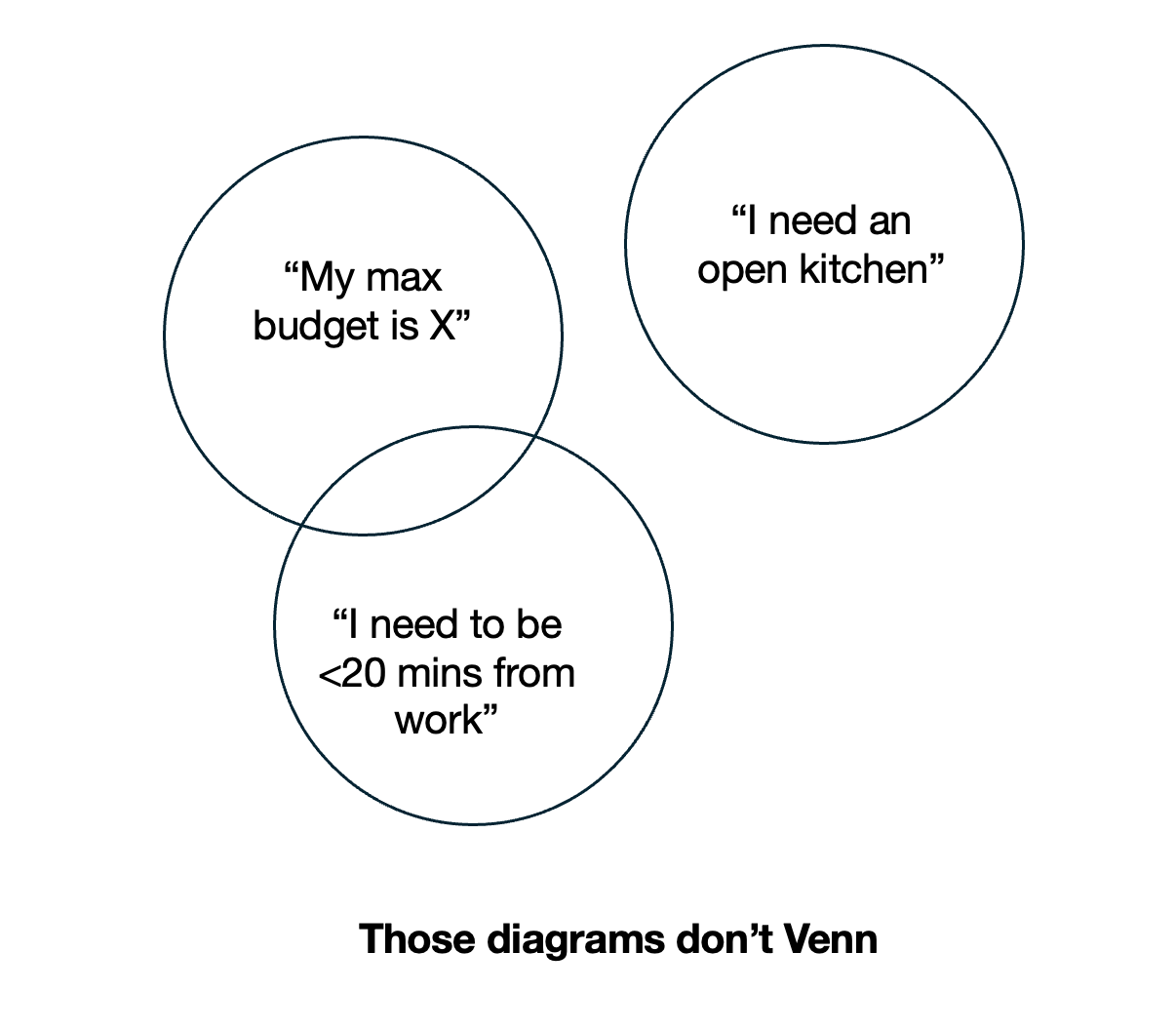
Now you need a place that works for everyone:
- Two households: ⅕ × ⅕ = 1 in 25. You'd need to look at ~25 suitable properties to find one that fits both.
- Three households: ⅕ × ⅕ × ⅕ = 1 in 125. Now you need ~125.
And remember — these can't be just any 125 homes. They have to be the kind of property that supports living near friends in the first place. Those are rare. You can probably count the ones currently for sale in your town on your fingers.
So if you want a single-family home just for yourself, go ahead and be as picky as you like — you've got a thousand options. But if you want to do this with people, you simply can't be that picky. The numbers won't allow it.
You're playing one of two games
When you go looking for a place to live, you can play one of two games — and the mistake most groups make is trying to play both at once.
The default game. You scroll through a thousand home listings and find the one that perfectly fits your preferences.
The live-near-friends game. You find one setup that makes living near your people actually possible — three homes in a row, a fourplex you split up, a duplex with room to build more. It might not check every box on your solo wish list. But it comes with something no perfect-on-paper house can offer: your friends, 20 feet away. That's the whole prize.
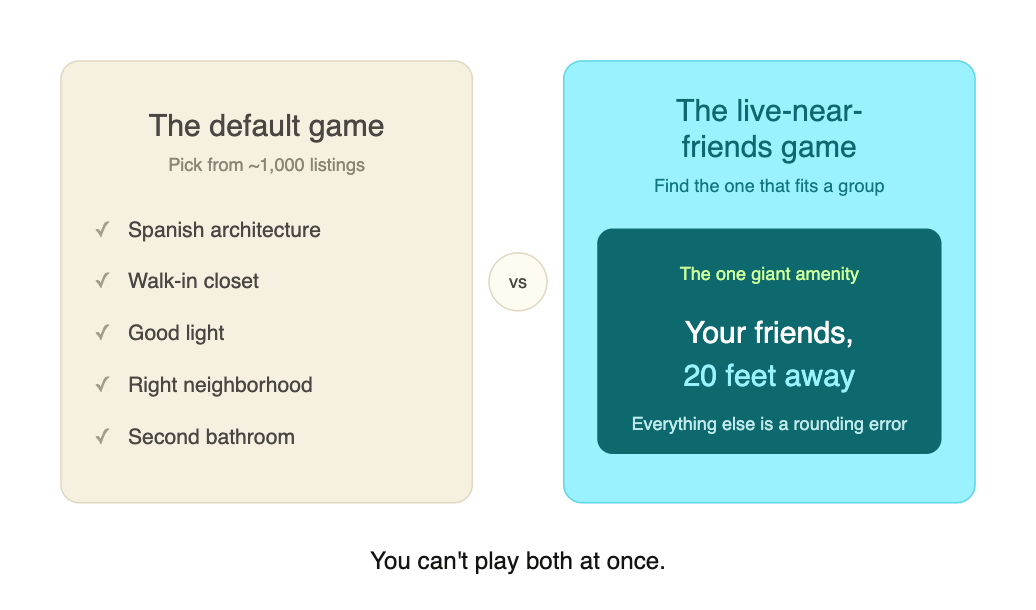
Here's the trap: if you bring solo-game pickiness to the live-near-friends game, you lose. You'll torpedo the one option that comes with friends-next-door because it failed a checklist item that only matters in the other game.
So how does it ever happen?
If group consensus is mathematically hopeless, how does anyone pull this off?
Like this: the one or two households who are ready take the leap. They find a place that works for them, they commit, and they trust that it'll work for the others once it's real and not just a hypothetical in the group chat. They leave room to grow incrementally like Joel and Sophia.
I'll tell on my own friends. Before my wife and I bought our place in Oakland (Radish), a bunch of the people who now live with us were firmly "nahh, we don't like Oakland."
Then the place was real. They came over. They felt what it was like. And they changed their minds — most of them live near us now. It turns out that community was the real amenity and that trumped location.
Here's what keeps me up a little at night: if those friends had been equal votes in the original decision, our compound wouldn't exist. Their perfectly reasonable preferences would have killed the whole thing before it started. The setup they now love only happened because, at the founding moment, not everyone got a veto.
It might not be these exact three people
Here's the pressure-release valve nobody tells you about: the three households who start the group chat are usually not the three who end up living next to each other.
And that's completely fine.
Maybe two of you are ready to move and the third keeps wobbling. Don't let the wobble kill it. The two committed households can buy their two homes, and the third place gets filled later — sometimes by the wobbly friend once it's real and they can finally see it, and sometimes by someone you weren't thinking of originally (that friend that moves to your city 6 months later).
This is the part people get backwards. They treat the original lineup as sacred — "it has to be exactly us three or it's not worth doing." So one person's cold feet sinks everyone. But the lineup was never the point. Living near good people was the point. Lock in the people who are ready, secure the homes, and trust that the right neighbor for the third spot will show up. They almost always do.
So you don't actually need all three yeses on day one. You need one household to decide, ideally a second to come along, and a little faith that the third chair fills itself.
—
So if you're sitting in a group chat right now with three excited friends and a slowly fading dream, here's my advice: stop hunting for the place that's perfect for everyone. It isn't out there.
Instead, figure out who's willing to take the leap — and let them.
Someone has to.
Thinking about living near your friends? That's the whole thing we do. We'll help you buy the place, and even build it if it doesn't exist.